Market-wide Half-Hourly Settlement (MHHS) is an Ofgem programme changing how your electricity use is measured and billed.

What it means for you
Instead of occasional meter readings, your electricity usage will be measured every half hour using smart meters. This means more accurate bills based on actual usage, better insight into when and how you use energy, and more control over your costs.
For most customers, MHHS will happen in the background with little or no impact on day-to-day operations. We’ll let you know in advance if you’re affected, your migration date and if any actions are required.

Why this matters
Better half-hourly data will help suppliers like us develop products and services for you, that are better matched to how you use your energy.
MHHS works alongside technologies like EV charging and battery storage. You’ll be able to use and store energy when it costs less, helping you reduce costs and get more value from your investment.
-
More accurate bills based on actual half-hourly electricity usage data
-
Clearer insight into when electricity is being used across your sites
-
Better energy management by identifying patterns and opportunities to reduce waste
-
Future access to more flexible products such as time-of-use tariffs or flexibility services, where available
-
Support for low-carbon technologies such as EV charging and battery storage, by helping you use energy more intelligently

When it's happening
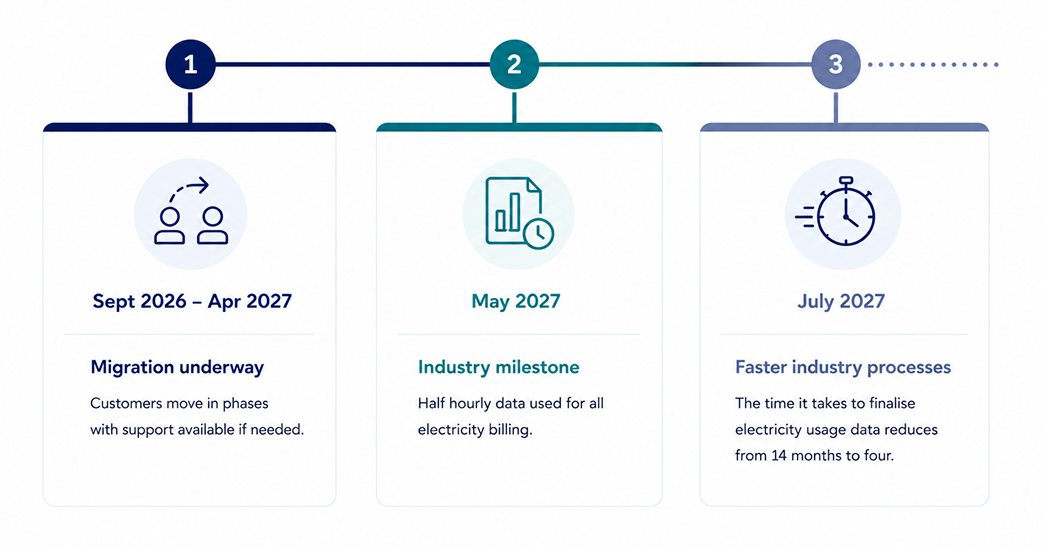
We’ll start moving customers to MHHS from September 2026 and expect to finish by April 2027. Ofgem’s wider milestones continue through mid 2027.
Timeline
Learn more about MHHS
Read our MHHS FAQs or speak to your account manager. You can also visit Elexon’s MHHS programme website for more detailed industry information.
Your MHHS questions answered
Your MPAN / Supply Number is usually on your invoice and may appear like the image below (see the Distributor ID). 
With the move to MHHS, Standard Settlement Configuration will replace Meter Time Switch Code, and Distribution Use of System (DUoS) Tariff ID will replace Line Loss Factor Class.
Profile classes 02 and 04 with traditional meters won’t change.
The profile class of all other non-half-hourly metered supplies will change to ‘00’ – this is the first two digits of the supply number on your bill.
Unmetered supplies and AMR Current Transformer (CT) meters will change profile class before migration to MHHS; followed by AMR Whole Current (WC), smart and single rate traditional meters.
These changes won't interrupt your supply or switch you to another supplier.
For some customers, changes may be needed depending on meter type and account set-up. If your billing frequency changes, we'll let you know what’s changing and when.
This is most likely to affect NHH AMR meters moving into the Advanced segment. These meters can use half-hourly meter readings, which typically support monthly billing.
We'll aim to move you to an equivalent tariff wherever possible. If an equivalent tariff isn't available, we'll move you to the closest suitable alternative. Before any changes are made to your account, we'll contact you to explain the replacement tariff and tell you how to get in touch if you'd like to discuss the change or have any questions.
We'll look at the key features of your current tariff, including how your energy is priced, any time-of-use periods and your meter setup. We'll then move you to the closest suitable alternative available. If we need to move you to a different tariff, we'll contact you before any changes are made to your account.
Your existing Flex contract terms and pricing arrangement will not change just because of MHHS migration. Any pass-through charges, trading arrangements or future pricing discussions will continue to be managed under your existing contract and through your usual account management process. Where applicable, agent charges will be included from the next interim bill after migration.
If your billing frequency changes, your payment schedule may also change in line with your existing payment terms. We'll confirm this if it applies to you.
It might. Some invoices may show your electricity usage differently, especially where half-hourly meter readings are used. We’ll explain any meaningful changes that affect you.
Under Market-wide Half-Hourly Settlement (MHHS), the roles of Meter Operators (MOPs) and Data Collectors (DCs) are changing. MOP services are moving to Metering Services, and DC services are moving to Data Services.
If you have appointed your own metering or data service providers, they must be qualified to operate under the MHHS arrangements. The impact on your agreement will depend on your chosen provider and the services they offer.
If your current provider is qualified under MHHS, they can continue to provide services after your migration. If they are not qualified or choose not to operate under MHHS, you'll need to appoint an alternative qualified provider, or we can appoint an approved provider on your behalf. If you're unsure whether your provider is affected, please contact them directly or speak to your account manager for support.
Energy suppliers will follow the updated industry Change of Agent process. We’ll work with you, as well as with metering and data service agents to make sure they’re appointed to the new roles correctly. Agents will still be responsible for managing metering equipment and collecting meter read and data information as they do now.
This process will affect existing and new customers. If you’re switching to us, we’ll carry out migration to MHHS during the registration process.
The impact of these changes will depend on your price plan and any new or additional costs we incur during this transition. We’re working through how MHHS impacts contracts and will let you know any changes to rates ahead of migration.
Due to the scale of this change and the new service processes and systems, we’re currently unable to predict these costs. We’re working diligently to finalise these. If we do need to add any additional costs, we’ll always inform you in writing beforehand.
Future costs across the energy industry will be lower with MHHS in place, than without this regulatory change. So, while costs may increase in the short term, they won’t rise as sharply, saving you money in the longer term. Ofgem predicts that GB consumers should see net benefits of £1.6bn-£4.5bn by 2045.
If a supply is unmetered, we’ll also need to appoint data and meter administration agents, so your bills will include additional fees.
We’ll use your half-hourly data primarily for forecasting and settlement purposes, to help us accurately predict energy demand and manage supply more efficiently. Additionally, we’ll use your half-hourly data to provide more accurate billing and to improve our product offering.
Our smart data guide and our privacy policy set out the standards you can expect from us when we request or hold your business’s information, including your half-hourly meter readings.
There's nothing you need to do. If metering or data services are required and you haven't appointed your own provider, we'll make the necessary arrangements on your behalf. If you'd prefer to appoint your own qualified provider, please contact your account manager for advice.
In most cases, there's nothing you need to do to prepare for MHHS. However, providing accurate meter readings and checking any estimated bills can help ensure your account is up to date before migration.
If you'd like to submit a meter reading, you can do so through Manage My Account or by contacting our customer service team. We'll let you know in advance if any further action is needed.
If you’re on our variable business rates, you can switch to another supplier at any time (if any amount due is unpaid we may object to the switch). However, all suppliers will be moving non-half-hourly and unmetered supplies to half-hourly settlement. Another supplier may require your supply to be updated before they register it, or they may update it themselves after registration.
If you have an existing contract, you can’t switch to another supplier until the contract end date. Once your contract expires, you’ll be free to switch to another supplier.
You can check your terms and conditions here.
For most customers with a smart meter, the change will happen mainly behind the scenes. You may notice more detailed information about electricity use or some small changes to how your data is shown.
Please use your usual support route to let us know. Accurate meter readings help us bill you correctly and support a smooth MHHS migration.
Yes. If you normally submit readings, please continue unless we tell you they’re no longer needed.
The impact of MHHS will vary depending on the types of meters you have. For example, smart meter customers may notice fewer visible changes, while NHH AMR meters may see changes to billing frequency or data services.
They may. Some reports could include new or renamed fields or show your electricity usage differently. We'll explain any changes that affect reports you use.
Yes, where this is part of your current service. If the way you access data changes, we will contact you with details.
Possibly. If your invoice frequency, format or account structure changes, please review this with your third-party provider once the impact is confirmed.
You're unlikely to notice many day-to-day changes because your sites already use half-hourly data. Some market roles, service names, data flows or reports may still change.
No. MHHS doesn’t automatically change your contract, tariff or agreed price.
Some reports may be updated. If a report you use is affected, we’ll explain what's changed and what it means for you.
- By 22 October 2025: All unmetered supplies switch to half-hourly settlement under the current setup. This is part of an industry change called Modification P434, to prepare for MHHS.
- October 2025 – May 2027: Unmetered and other supplies move to the new MHHS system over 18 months. This may mean further updates, like changes to metering and data services.
No, you don’t need to have a meter installed. Your supply will continue in the same way.
Yes. When your supply moves to half-hourly settlement, multiple MPANs will be merged so there’s only one MPAN per inventory. Any extra MPANs will be removed, and their energy use will be combined with the remaining MPAN.
The primary supply number (MPAN) that will be retained will appear on your invoice.
No, all your unmetered supply equipment will remain connected. If you want to make changes to your equipment or its energisation status, please contact your UMSO.
You can find a list of UMSOs, their contact details and which MPANs they cover here.
This role is defined by the electricity industry to manage unmetered supplies, making sure the arrangements for unmetered supplies are correctly applied. Each electricity network operator appoints a UMSO who ensures the following:
- Establishing a connection agreement
- Maintaining an accurate inventory of unmetered equipment
- Creating and updating an Unmetered Supplies (UMS) Certificate.
A phased plan and early migration for unmetered supplies will allow plenty of time ahead of the MHHS transition for suppliers and Unmetered Supply Operators (UMSOs) to resolve any issues that may arise.
This is an industry-wide regulatory change that all unmetered supplies must undergo, mandated by Ofgem under P434. All energy suppliers are updating unmetered supplies to comply with this change by October 2025.
If you’re on our variable business rates, you can switch to another supplier at any time (if any amount due is unpaid we may object to the switch). However, all suppliers will be moving unmetered supplies to half-hourly settlement. Another supplier may require your supply to be updated before they register it, or they may update it themselves after registration.
If you have an existing contract, you can’t switch to another supplier until the contract end date. Once your contract expires, you’ll be free to switch to another supplier.
You can check your terms and conditions here.
Yes, your unmetered supplies will now be billed monthly.
Yes, we’ll create a new invoice structure number for you, but your billing details, like direct debits and electronic billing will stay the same. If you have multiple sites grouped on one bill, we’ll keep them grouped together in your new invoice structure.
If your existing contract ends before the change of measurement class is completed, you can get in touch with us to discuss your options. Otherwise, you’ll be temporarily placed on our VBR NHH Street lighting / Unmetered supplies tariff; then after the change, you’ll move to our VBR HH unrestricted LV and LVS tariff. You can find our VBR here.
The impact of these changes will depend on your tariff and whether you have multiple supply numbers (MPANs) within your unmetered equipment inventory (as agreed with your Unmetered Supply Operator (UMSO).
You’ll pay one standing charge per inventory instead of several.
You’ll move to our VBR HH unrestricted LV and LVS tariff. You can find more information about our current VBR on our out of contract rates webpage
Your existing rates will not be affected by the change of measurement class. We’ll incur higher costs when we move your supply to half-hourly settlement, but we won’t pass these on to you.
When your contract ends, the renewal offer will be based on half-hourly settlement.
Your invoice will include additional charges to cover the cost of your data collector and meter administrator. We’re appointing these agency services under the regulatory obligation to prepare for MHHS.
When your contract ends, the renewal offer will be based on half-hourly settlement.
All AMR metering in Britain will align to how half-hourly meters operate, to record and bill consumption every 30 minutes.
In most cases, no. For many customers, the transition to MHHS will happen automatically and won't require any changes to their meter.
However, in some circumstances, a meter exchange or other metering work may be needed if your meter is unable to provide the data required under the new arrangements. We're working with our metering and data service providers to identify any affected customers.
If any action is needed for your meter, we'll contact you directly to explain what is required and, if necessary, arrange an appointment at a convenient time. There is nothing you need to do unless we contact you.
Under the new rules, your bill will be a total of the energy you used in every 30-minute interval during that billing period.
If you’d still prefer to get bills based on meter readings, your AMR meter will need to be exchanged to a smart meter, which you may be charged for.
All CT meters will move to half-hourly settlement and billing from March 2026, as part of P432.
We’ll be in touch with affected customers from February 2026. If your CT meter isn’t collecting half hourly data, it may be exchanged. You won't be charged for this.
P432 is a regulatory requirement that ensures all CT connected advanced meters currently settled non-half-hourly are updated to half-hourly settlement by suppliers. It’s mandatory, introduced by Elexon and approved by Ofgem as an early step of the MHHS rollout.
If you’re on an SSE Protect or SSE Choice plan, your pricing will remain as set out in your contract.
If you’re on a flexible plan, half-hourly pricing and billing will now apply to your CT supply.
If you have a CT meter and are on our variable business rates (VBR), your tariff will be updated to VBR Business HH (Measurement Class (MC) C&E). Please see our current VBR pricing details.
Whilst we aim not to change your IST, there may be circumstances that mean we need to do so. If changes are made, you’ll be able to see them on your next invoice, and billing will run concurrently between ISTs.
MIC is the maximum electrical capacity (in kVA or MW) the Distribution Network Operator (DNO) makes available to your site at any time. It's also known as 'available capacity'. All half-hourly customers must have an agreed MIC. If you exceed it, available capacity charges apply, which can be much higher than standard rates.
If your CT meter is currently non-half-hourly, to give you time to understand your usage, you won’t be charged for available capacity for the first 12 months following the update to half-hourly. We recommend reaching out to your DNO to confirm your MIC within 12 months. If you don’t contact them, they’ll calculate this based on the highest peak recorded during that time.
Unsure which DNO covers your supply? You can find a list here.
Not always. Sites may move at different times depending on meter type, readiness and the phase your site falls into.
If you have a more complex portfolio, your customer pack will explain the affected sites, expected migration window and any action you need to take.
Your electricity supply is part of a scheduled MHHS migration group. All customers will move to the new arrangements as part of the industry-wide programme. The impact on your account will depend on your meter type and current arrangements, and we'll let you know in advance if any action is required.
In most cases, no. MHHS changes will happen without the need for a site visit or meter exchange.
However, if work is required at your site or meter, we'll contact you in advance to explain what's needed and arrange an appointment if necessary. There is nothing you need to do unless we contact you.
For most customers, there's nothing you need to do right now. Please read any updates we send and keep your contact details up to date. If we need information from you, we'll get in touch and explain what's required. If you've appointed your own metering or data service providers, please check they're ready for MHHS.
MHHS is a game-changer for the energy industry and for you as a customer. For more information, speak to your account manager, visit the MHHS Programme website or click the button to talk to our team.
